As technology has become an integral part of everyday life, filling our lives with instant access to images, sounds, and information, and as cultural barriers continue to fade, it is no surprise that subtitling various audiovisual content has reached new heights. Subtitling audiovisual programmes has become crucial not only for accessibility, such as for the deaf community - expected to exceed 700 million people with disabling hearing loss by 2050 (Deafness and Hearing Loss, 2023) - but also for its significant role in foreign language education (Aksu Ataç & Günay-Köprülü, 2018; Hestiana & Anita, 2022). Furthermore, subtitles serve marketing purposes by improving SEO rankings for videos online, thereby drawing in more viewers and potential customers.
Subtitling, one of the three main ways of translating such programmes (alongside dubbing and voice-over) (Díaz-Cintas & Remael, 2014, p. 8), is considered part of the broader field of audiovisual translation (AVT) encompassing "media translation", "multimedia translation", "multimodal translation" and "screen translation" (Chiaro, 2009, p. 141). As times and demographics change, statistics reveal that 70% of American Gen-Zers and 53% of American Millennials watch their digital content with captions or subtitles turned on, due to these generations' viewing preferences and to their upbringing in highly digitalised environments (Survey, 2022).
A key challenge in subtitling has always been conveying culture-bound items (CBIs) to audiences from different cultures, particularly when there are significant differences between the source and target cultures. Given the lack of research in this specific area, especially within Romanian literature, this paper seeks to fill that gap by offering insights into how Romanian subtitlers have approached the translation of culture-specific items in films, with a focus on the crime drama series Southland (Southland (TV Series), 2024).
Literature review
Subtitling
Subtitling, a relatively new method of translation, gained recognition in the 1970s when it started being used for television programmes. Progress was made in the 1990s when the UK introduced a legal requirement for closed captions to accommodate deaf and hearing-impaired viewers (The History of Subtitles: Past, Present and Future, 2017).
Subtitling has received many definitions, being regarded as "a translation practice that consists of presenting a written text, generally on the lower part of the screen" (Díaz-Cintas & Remael, 2014, p. 8), "the process of providing synchronized captions for film and television dialogue" (Shuttleworth & Cowie, 1997, p. 161), being at the same time "a cheap, quick, foreign culture friendly mode of screen translation" (O'Connell, 2016, p. 67) as opposed to dubbing.
Dubbing is the process of substituting the original spoken dialogue in a film, television show, video, or other audiovisual content with dialogue in a different language, performed by voice actors. Countries such as Germany, Italy, and Spain adopted dubbing in the 1930s, primarily for nationalistic reasons. However, it appears to be losing ground to subtitling, which is more cost-effective (as it does not require actors) and retains the original performance, emotion, and nuances envisioned by the filmmakers. Romania is a country that uses subtitling as opposed to Hungary or Austria, which use dubbing as a preferred way of screen translation.
Despite its advantages, subtitling has its own drawbacks and limitations, including the need for reading, which can be challenging for individuals with reading difficulties. Additionally, spatial and temporal constraints can result in condensed or simplified translations (Delabastita, 1989, p. 20), potentially leading to the omission of important details. Scholars (Carroll & Ivarsson, 1998; Díaz-Cintas & Remael, 2014; Pedersen, 2011a) have agreed upon the technical criteria for the subtitle format on the screen, i.e. 20% of screen space for subtitles on screen (2 lines) and a maximum of 42 characters per line for Latin alphabets.
Moreover, subtitling requires linguistic skill, cultural sensitivity, and technical expertise to ensure that the subtitles enhance accessibility and comprehension without detracting from the viewing experience.
Difficulties of being a subtitler
Being a translator is inherently challenging, as it requires not only a deep understanding of both the source and target languages in terms of grammar but also an awareness of the cultural differences between them. When it comes to subtitling, this task becomes even more demanding. The above-mentioned constraints, along with the various techniques subtitlers must employ "to make ends meet" classify subtitling as a "constrained translation" (Mayoral et al., 1988; Titford, 1982) or a "vulnerable translation" (Díaz-Cintas, 2003, p. 43), since viewers may question the translator's methods without fully understanding the complexities of this form of translation.
Culture-bound items in subtitling
The relationship between language and culture is symbiotic and dynamic, each continuously influencing and reshaping the other. That is why cultural items are regarded as one of the most challenging aspects for translators, who must also take on the role of cultural mediators (Katan, 1996).
One of the challenges encountered by subtitlers is the translation of culture-related items which Newmark (Newmark, 1988) classifies into five categories (ecology, material culture, social culture, organisations, customs, activities, procedures, ideas, and gestures and habits). As films are "... products of the culture from which they arise" (Nedergaard-Larsen, 1993, p. 207), they are naturally filled with cultural references. It is the translator's responsibility to accurately and thoroughly convey these references in the subtitles to "recreate" the foreign cultural context and help the audience understand and familiarise themselves with it.
Translation strategies for culture-bound items
Throughout the time, scholars have developed different translation strategies meant to help translators in their endeavour of dealing with culture-bound items. Nedergaard-Larsen (Nedergaard-Larsen, 1993) proposed strategies such as verbatim transfer, culturally neutral explicitation, paraphrase and target language adaptation. Following this, (Tomaszkiewicz, 2001) suggested approaches including omission, transfer direct, adaption and substitution. On another note, Leppihalme (Leppihalme, 1997) concentrated on strategies used for translating allusions or culture bumps.
Pedersen's model (Pedersen, 2005) is the most comprehensive and detailed framework, classifying culture-bound items into intralinguistic and extralinguistic culture-bound references. Intralinguistic references encompass idioms, slang, proverbs while extralinguistic references pertain to non-linguistic cultural elements, such as names of people, places, and institutions. The importance of masterfully translating extralinguistic culture-bound references (ECRs) is paramount when subtitling since "a person might be linguistically competent in a foreign language while still being culturally illiterate in a culture which uses this language" (Pedersen, 2011b, p. 47). Pedersen categorises the translation strategies employed for the rendering of extralinguistic cultural elements into source-language oriented (having three techniques, i.e. retention, specification and direct translation) and target-language oriented (i.e. generalisation, substitution and omission) and further divides them into different translation sub-techniques (see Figure 1).
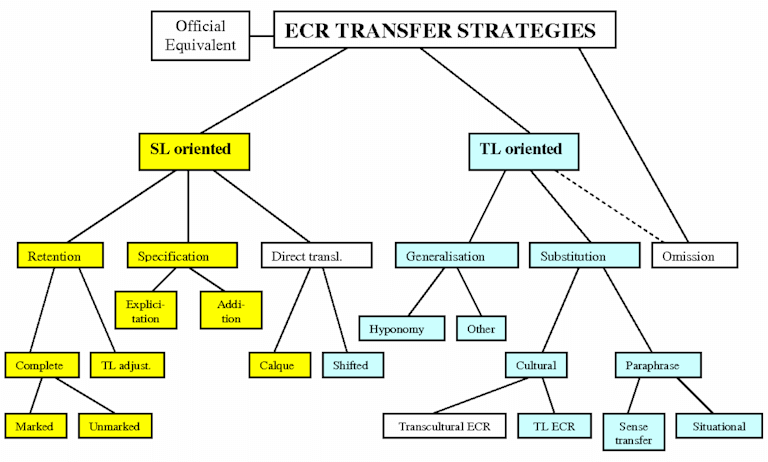
Pedersen further posits that his model would most probably solve any extralinguistic culture-bound translation problem. In the author's opinion, Pedersen’s framework stands out as the most comprehensive one when it comes to the subtitling strategies available to Romanian subtitlers.
Crime drama genre
In line with Nedergaard-Larsen's view (Nedergaard-Larsen, 1993, p. 221) that genre influences the translator’s choice of translation strategies, it is important to emphasise the fact that crime drama genre is rich in culture-bound items since the law enforcement systems and the police jargon differ in the two cultures being analysed.
Methodology
Terminology
It must be pointed out that there is no consensus on the terminology used to describe the cultural elements in translation. Various scholars have chosen different terms, such as realia (Florin, 1993; Leppihalme, 1997), cultural words (Newmark, 1988), cultural-specific items (Aixelá, 1996), culture specific references (Gambier, 2004), culture-bound problems (Nedergaard-Larsen, 1993). Pedersen (Pedersen, 2005) initially introduced the term extralinguistic culture-bound references, which he later revised to extralinguistic cultural references in 2011. In this paper, the term extralinguistic culture-bound references (ECRs) will be used in accordance with Pedersen’s definition of culture-bound items, as it highlights the nature of the terms analysed in the study:
Extralinguistic Culture-Bound Reference (ECR) is defined as reference that is at-tempted by means of any culture-bound linguistic expression, which refers to an extralinguistic entity or process, and which is assumed to have a discourse referent that is identifiable to a relevant audience as this referent is within the encyclopedic knowledge of this audience (Pedersen, 2005, p. 2).
This study employs both qualitative and quantitative approaches, initially analysing the corpus of the subtitles collected by the author and subsequently categorising it based on Pedersen’s model of translation strategies from both qualitative and quantitative perspectives.
Corpus
The corpus consists of episodes from seasons 1 and 4, totalling around 5,000 subtitles, translated by multiple subtitlers, including the author. The analysed series is Southland, a crime drama that began streaming on HBO Max in Romania in 2020. Southland portrays the lives of the police officers in the Los Angeles Police Department.
Analysis
The analysis of the subtitles was conducted using Pedersen’s model for translating ECRs (discussed above). This model is applied to the existing corpus to identify the most commonly used translation strategies by Romanian subtitlers. It will also highlight how these strategies are used to adapt the ECRs in this particular film genre for a Romanian audience unfamiliar with American police jargon. The research questions examined in this study are as follows:
- What types of extralinguistic cultural references are present in this film genre?
- What translation strategies have the Romanian subtitlers employed to address these references?
Discussion
As outlined above, Pedersen’s model for translating ECRs will be applied to the translation of the Southland episodes. The following section will present and discuss the strategies employed by the translators.SL-oriented strategies
Retention.
Retention is the translation strategy that is the most faithful to the source text. It can be either “complete” or “adjusted” for the target audience. In the former case, it may be “marked” (using inverted commas or italics) or “unmarked”, while in the latter case, minor spelling modifications may be made (Pedersen, 2005, p. 4). Examples from the corpus are provided in Tables 1a and 1b and explained thereafter.
Retention as a translation strategy (complete)
[A-57, răspundem noi.]
2. A-36 in pursuit of an ADW suspect,
in the alley off the corner of 113th and Bay.
[A-36 urmărește un suspect înarmat
pe aleea dinspre strada 113 și Bay.]
3. Just another beautiful day
to be a police officer in the city of Los Angeles.
[O altă zi frumoasă
să fii polițist în Los Angeles.]
4. - ”Someplace tropical”. Man.
- Would the Club Med in the Bahamas be ok?
[- „Undeva tropical”. Omule! - E bine în Club Med în Bahamas?]
5. A-36 shots fired in the alley
off 8th street and Concord. In pursuit.
[A-36, focuri de armă pe aleea
de pe strada 8 cu Concord. Urmărim.]
6. Show us what you got RoboCop.
[Arată-ne ce poți, RoboCop.]
next time for happy ending.
[Sayonara, 57. Să vii data viitoare
pentru un final fericit]
8.Welcome to Gabriella’s quinceañera.
Angela and I cannot believe
that our baby is 15.
[Bine ați venit la quinceañera Gabriellei!
Mie și Angelei nu ne vine să credem
că are 15 ani.]
9. You like dim sum? I know a place.
[Iți place dim sum? Știu un loc.]
Retention as a translation strategy (TL adjusted)
driven by some knucklehead
with a shit look on his face.
[Uitați-vă după niște Corolla
conduse de un idiot
care arată ca un rahat.]
11. What’s it like living in The Truman Show?
[Cum e în Truman Show?]
12. It’s a long time to be lugging
that 15-pound Sam Browne
all over the place.
[E mult să cari după tine
un Browne de șapte kilograme.]
In examples (1), (2), (3), (4) and (5), complete and unmarked retention is used. “A-57” and “A-36” are police car identifiers that cannot be translated for the Romanian audience, as they are simply numbers and letters for differentiation. In (3), the name of “Los Angeles” remains untranslated, as does the well-known hotel chain “Club Med” in (4), and the iconic character “RoboCop” in (5).
Sometimes the word is fully retained but marked, as seen in example (7), where the speaker uses the Japanese term “Sayonara”, meaning “good-bye” in English. For contextual reasons, it is left untranslated in Romanian, but being a foreign word, it is written in italics, similar to its use in English. A related case occurs in (8) with the Spanish word “quinceañera”. Since the film is set in Los Angeles, home to a large Spanish-speaking community, the subtitler has chosen to retain the word, likely due to space constraints and to preserve its cultural significance, as translating “quinceañera” into Romanian would require a paraphrase. In (9), the Chinese snack name “dim sum” is also retained in italics, and as in (8), a paraphrase in Romanian would have taken up too much space.
The translated words are still retained in Romanian but adjusted to fit the context for Romanian viewers. For instance, in (10), the plural form of “Corollas” is omitted in the Romanian translation. Similarly, in (11), the definite article is dropped from “The Truman Show”. A more notable example of retention, but with adaptation for the target audience, is seen in (12), where a potential mistranslation occurs, in the author’s opinion. The name “Sam Browne”, which refers to a type of police belt, is retained in Romanian even though “Browne” does not signify anything related to belts in this language. A more accurate translation would have used the hypernym “belt”. It appears that the subtitler might have misunderstood “Browne” as an eponym, like “Colt” (which is retained as such in Romanian), but this is not applicable in this case.
It must be mentioned that this analysis has provided the author with a new situation, not found in Pedersen’s framework, that was named partial retention or cultural retention, and which will be presented as follows:
- Get out of town.
[- Am auzit ca merge cu Tang.
- Fugi de aici!]
“Pootie Tang” is a play on the name “Tang” (Jessica Tang), which, in this context, carries a vulgar connotation, referring to “vagina”. This reflects the misogynistic jokes made by male officers about their female colleagues, a common occurrence in maledominated professions. In this instance, the subtitler has opted for partial retention, keeping only the name “Tang”, which is familiar to the audience, while omitting the crude pun associated with “Tang”, a wordplay understood primarily by native speakers.
Specification.
The specification strategy refers to the process of making a cultural reference more explicit by clarifying a term (“explicitation”) through something that is “implicit in the ST” (Pedersen, 2005, p. 4) or by adding information (“addition”) in the target language. It is used when a term in the source language is either too vague or not easily understandable for the target audience due to cultural differences. The translator provides additional details to ensure that the audience fully understands the reference. This strategy is crucial in maintaining the cultural integrity of the source material while making it accessible to a broader audience. The examples for the specification strategy can be found in Table 2.
Specification as a translation strategy
1600 block, Cahuenga Boulevard.
[Trimiteți o ambulanță
pe Bulevardul Cahuenga, nr. 1600.]
15. It was an ADW call.
[Era un apel pentru asalt cu arma.]
16. - Hey, boot.
- P-2 now.
[-Bună, răcane!
- Sunt agent plin acum.]
17. Now she’s ”Grambo” forever.
[Acum e „mamaie Rambo”.]
[Pe aleea dinspre strada 113 și Bay.]
19. The Six-Fours come back,
it’s going off. You know it.
[Dacă se întoarce banda 64,
e de rău și știi.]
In example (14), “RA” is an abbreviation unfamiliar to the Romanian audience, as it is specific to the Californian culture and stands for “Rescue Ambulance”. The subtitler has chosen to clarify this by using the word “ambulance” in Romanian, which is implied in the original term. Similarly, in (15), the abbreviation “ADW” (assault with a deadly weapon) is explained, offering an explicitation of the police code. A comparable case appears in (16), where “P-2” is translated as “agent plin” (“full agent”) in Romanian. “P-2” refers to an officer rank just above rookies (“răcan”) in the LAPD, a concept again unfamiliar to Romanian viewers. In example (17), irony is expressed through the portmanteau word “Grambo”, combining “grandmother” and “Rambo”. Given that many Romanian viewers recognise the Rambo character, the subtitler has decided to deconstruct “Grambo” into its individual elements for clarity, translating it as “Grandma Rambo” (“mamaie Rambo”).
In example (18), on the other hand, the subtitler has opted to explain “113th” by adding that it is a street, a necessary clarification since Romanian viewers may not be accustomed to streets being named by numbers. A similar approach is taken in example (19), where “Six-Fours”, an American gang likely unknown to most viewers, is translated with a hypernym (“banda 64”) (“gang 64”) to make it more understandable for the Romanian audience.
Direct translation.
In Jan Pedersen’s taxonomy, calque and shifted direct translation are part of the direct translation category, used when the subtitler resorts to maintain a close connection to the source text. While a calque is a direct, word-for-word or phrase-for-phrase translation that maintains the structure of the original language being sometimes seen as “exotic” (Pedersen, 2005, p. 5), a shifted direct translation involves making slight adjustments to the source text. The shift typically ensures that the target text remains idiomatic and natural, being more “domestic” (Pedersen, 2005, p. 5). Table 3 presents the calque and shifted direct translations found in the present corpus.
Direct translation strategy
[Care-i treaba, ofițer Sherman?]
21. Well, I’m sorry about that, Officer.
I have truly done my best.
[Îmi pare rău pentru asta, dle ofițer.
Am făcut tot ce am putut.]
22. Officer Sherman! Hi.
I hope I haven’t kept you waiting long.
[Ofițer Sherman. Bună!
Sper că nu te-am făcut să aștepți mult.]
23. Actually, it’ll be 22 in April, Sarge.
[De fapt, se fac 22 de ani in aprilie, dle sergent.]
- Officer Cooper. Officer.
[- Sau „Espresso Singurel”.
- Polițist Cooper.]
The translations in (20), (21), and (22) represent typical instances of calque, which in this context result in mistranslation in Romanian. This is because “ofițer” in Romanian refers to a military rank and is not typically used for police officers. As a result, the term “ofițer” feels out of place in this context. A more appropriate domestic alternative would have been “domnule ofițer de poliție” (“Mr. Police Officer”) (a generic phrase for police officers, though too lengthy) or simply “domnule polițist” (“Mr. Policeman”). Another instance of mistranslation appears in (23) with the term "Sarge," which is a military rank not found in police hierarchies. It is worth noting that the subtitler has duly obeyed the grammatical and stylistic conventions in Romanian by using the polite form of address “domnule” (abbreviated as “dle”) alongside the rank title – “dle ofițer”, “dle sergent”. In this case, “Sarge” could have been translated, albeit not with a perfect equivalent, by “comisar” or “chestor”. In example (24), “officer” is the only case where the translation has been adapted for the Romanian viewers, being rendered as “polițist”, a term that resonates more naturally with the Romanian audience.
TL-oriented strategies
Generalisation.
Generalisation for Pedersen (Pedersen, 2005, p. 6) involves substituting a specific term or concept (a hyponym) with a broader, more general category (a hypernym) in the target language. Hyponymy is a linguistic relationship where one term (the hyponym) is a more specific instance of a broader category (the hypernym). This strategy is particularly useful when the translator assumes that the target audience may not be familiar with the specific term or reference in the source language, and a broader term is sufficient to convey the overall meaning. Concrete examples are presented in Table 4.
Generalisation as translation strategy
[Aia e banda care te vrea terminat?]
26. We were looking for 3rd Street
and MapQuest took us to 3rd Avenue.
[Căutam strada 3 și GPS-ul ne-a dus pe bulevardul 3.]
27. Cut that ... up with some Stoli
and you’re on your way.
[Dacă o iei cu niște votcă, poți să pleci.]
In example (25), a hypernym (“banda” or “the gang”) is used in place of the gang's name (“Six-Four Hustlers”) since it would not hold meaning for Romanian viewers. A similar approach is taken in example (26), where “MapQuest”, a GPS app, is substituted with “GPS” because the latter is more widely recognised by the Romanian audience. Additionally, in example (27), “Stoli” refers to a vodka brand from the USSR. Again, it was translated by generalisation, by using a hypernym instead (“vodka”). Generalisation via hyponymy is an effective tool for making culturally specific terms more accessible to the target audience by replacing them with broader, more familiar terms.
Substitution.
Two commonly used strategies for dealing with extralinguistic culture-bound references (ECRs) by Pedersen are cultural substitution and paraphrase. Both strategies aim to address the challenge of translating culture-bound elements that may not be easily understood by the target audience, but they do so in different ways.
Cultural substitution.
In Jan Pedersen’s framework for audiovisual translation, particularly when dealing with extralinguistic culture-bound references (ECRs), the concept of cultural substitution involves replacing a culture-bound reference from the source language with a reference that is more familiar to the target audience. Based on the level of familiarity to both the source and target audiences, this can be done either through transcultural ECRs or target language ECRs (TL ECRs) (Pedersen, 2005, pp. 6–7). A transcultural ECR is a cultural reference that exists in multiple cultures or is widely known across different cultures, including both the source and target cultures (e.g. official equivalents). These references are often global or international in nature and can be understood without the need for translation or adaptation, while target language ECRs refer to a cultural reference that is specific to the target culture and familiar to the target audience and is the most “domesticating” (Pedersen, 2005, p. 7) translation strategy, used for official institutions and titles. This strategy is also used in the present corpus by the subtitlers (see Table 5).
Cultural substitution as translation strategy
for Fast & Furious 6.
[Cică-s interesați de tine
pentru Furios și iute 6.]
29. It’s gonna take Jesus.
[Numai Iisus]
30. I dialed 911.
[Am sunat la 112.]
31. What is this, ghetto Cinderella?
[Cenușăreasa din ghetou?]
32. So, which Ben Bunny was it last night?
[Care „iepuraș” a fost azi-noapte?]
2,000 feet from a school,
300 feet from a child-safety zone,
500 feet from a public park.
[N-avem voie la 600 m. de școală,
90 m. de o zonă pentru copii
și 150 m. de un parc public.]
34. Okay, great.
Truck Norris will be on Franklin at 1.
[Bine, grozav.
Truck Norris va fi pe Franklin la ora 13:00.]
35. Not to mention the pool,
which is like badge bunny central.
[Să nu mai vorbim de piscină,
care atrage puicuțe.]
In example (28), the subtitler has preferred the official translation of the well-known film The Fast and the Furious, given its familiarity with the target audience. Similarly, in examples (29) and (31), the names “Jesus” and “Cinderella” were translated using their official equivalents. In example (30), the subtitler has replaced the emergency number “911” with its Romanian counterpart, “112”, which is more recognisable by the Romanian audience. Example (32) features irony and sarcasm, which are especially difficult to translate, particularly when tied to a cultural reference. In this instance, the speaker refers to Ben Bunny, a book character well-known to English-speaking children but unfamiliar to Romanian audiences. The reference plays on the idea that the interlocutor, who has a child at home, should have been reading a bedtime story but instead went out in search of female companionship. To adapt this, the subtitler has opted for a culturally relevant equivalent, using a term in quotation marks to describe a woman associated with the iconic Playboy “bunny” figure, a reference that many Romanian viewers would recognise.
In contrast, examples (33) and (34) showcase cultural translations where the unfamiliar ECR is substituted with a reference from the target culture, such as converting feet (imperial system) to meters (metric system) or adjusting the time format from 1 p.m. to 13:00. Unlike example (32), in (35), the subtitler has decided not to retain the cultural reference in quotation marks, opting instead for a target culture equivalent. Instead of using “bunny” to describe women, s/he has chosen a more familiar Romanian term, replacing “bunnies” with “chicks” (“puicuțe”).
Paraphrase.
Paraphrase involves rewording or explaining the cultural reference from the source language in more general terms that make it comprehensible to the target audience. This strategy is often used when there is no direct equivalent or when cultural substitution is not feasible. The translator rephrases the meaning of the cultural reference without replacing it with a specific reference from the target culture. Jan Pedersen’s two types of paraphrase strategies—paraphrase with sense transfer and situational paraphrase—offer flexibility in handling cultural references in subtitling.
Paraphrase with sense transfer involves rewording the cultural reference while maintaining its core meaning and communicative purpose. This type of paraphrase does not introduce new information but reformulates the original message to make it clearer to the target audience.
The situational paraphrase involves rewording or describing a cultural reference by providing an explanation of the situation or context. This type of paraphrase often introduces new information or explanatory context to help the target audience understand the cultural reference. Unlike the paraphrase with sense transfer, the situational paraphrase adds extra detail to explain why the reference is relevant or what it means in the original context. It should be mentioned that this type of paraphrase was not used by the subtitlers of this corpus. Table 6 synthesises the examples of paraphrase with sense transfer found in the corpus.
Paraphrasing as translation strategy
[Lasă-i pe alții să salveze curvele.]
37. It was either this or Teach for America.
[Ori aici, ori ca profesor la sate.]
38. The fact that they just happen
to cite every vehicle owned by a Two Trey,
skipped all the rest.
That part’s a little weird.
[Faptul că au mentionat toate vehiculele de fițe
și le-au sărit pe celelalte
e cam ciudat.]
In (36), the translator chose to paraphrase “Captain Save-A-Hoe”, a derogatory American term coined by rapper E-40, referring to a man who goes to great lengths for promiscuous women, as it likely would not be understood by Romanian audiences. The phrase was adapted to mean “let others save the hoes”. A similar paraphrasing strategy is applied in (37), where “Teach for America”, an organisation serving underprivileged schools and communities, is not well-known in Romania. The translator has rephrased it as “teacher in the rural areas”. In (38), “Two Trey” refers to Michael Jordan, who had the number 23 on his jersey, used “Two Trey” on his license plate, and had a sneaker line named after him. Since this information may not be widely known among Romanian viewers, the subtitler has adopted the paraphrase, conveying the intended meaning—that a vehicle owned by a “Two Trey” is a luxury car—by using the Romanian term “vehicul de fițe” (“a flashy car”).
In what follows, using MAXQDA software, the typology of extralinguistic culture-bound references found in the Southland series, typical of police genre films, along with their frequency in the analysed corpus, is presented in Table 7 below.
Types of ECRs in “Southland” and their frequency
| Types of ECRs | Freq. (%) |
|---|---|
| Names of police ranks | 91.2 |
| Police terminology (car codes, abbreviations, acronyms) | 89 |
| Names of streets, boulevards, buildings | 78.7 |
| Foreign words (related to food, people, customs) | 67 |
| Ironic/sarcastic phrases involving a cultural reference | 51 |
| Well-known cultural figures and symbols (e.g. Cinderella, Jesus, Robocop, Rambo) |
48.6 |
Considering the significant number of ECRs in the analysed episodes, the paper explores the subtitlers' choices regarding the translation strategies, along with their preference for them.
Types of translation strategies used by Romanian subtitlers for ECRs in “Southland”
| Types of translation strategy | Freq. (%) |
|---|---|
| Retention | 85.6 |
| Cultural substitution | 74.8 |
| Specification by explication | 67.8 |
| Direct translation | 55.9 |
| Paraphrase with sense transfer | 46.3 |
| Generalisation | 34 |
Conclusion
The analysis of subtitling strategies employed in the Southland series provides valuable insights into how Romanian subtitlers handle extralinguistic culture-bound references (ECRs), particularly within the context of police dramas. By applying Jan Pedersen’s model (2005) for ECR translation strategies, this study has revealed patterns that reflect the complexity of adapting culturally specific terms for a foreign audience.
Source-language oriented strategies, such as retention (85.6%), were frequently used to maintain cultural authenticity. Retention was either complete or adjusted for Romanian viewers, demonstrating the subtitlers’ commitment to preserving the original cultural context of the source material. However, in some instances, subtitlers have opted for partial retention, a strategy not found in Pedersen's model, where they have preserved part of a cultural reference and have omitted another to facilitate understanding without losing too much of the original meaning.
Specification strategies were also prevalent, where subtitlers have made implicit information explicit to aid understanding (67.8%). Specification was employed when subtitlers needed to clarify abbreviations or cultural references unfamiliar to Romanian viewers. This strategy has helped to make implicit cultural items, such as police codes and location names, explicit and accessible, ensuring that Romanian audiences could follow the context and narrative more easily. Direct translation (55.9%), which includes both calque and shifted direct translation, was used to maintain a close connection with the source text. However, some calque translations resulted in mistranslations, especially when dealing with military and police ranks unfamiliar in Romania. This highlights the limitations of strict word-for-word translations when cultural contexts diverge significantly.
On the other hand, target-language oriented strategies, particularly generalisation (34%) and cultural substitution (74.8%), were employed when cultural references were too specific or obscure for the Romanian audience. In cases where the Romanian audience might not be familiar with a particular reference, subtitlers have preferred to either broaden the meaning (through generalisation) or replace it with a culturally equivalent term or phrase. For example, references like “bunny” in American culture were adapted to “chick” in Romanian, making the translation more accessible to local viewers. This approach underscores the subtitlers' role as cultural mediators, adapting content to suit the target audience's cultural context (Katan & Taibi, 2021). By using broader terms or explanations, subtitlers have ensured that the core message was retained, even if some cultural nuances were lost. Paraphrase with sense transfer (46.3%) was another effective strategy, allowing subtitlers to reformulate certain cultural references while retaining their original meaning. This approach has ensured that key narrative elements and cultural nuances were preserved, even when direct translation was not feasible. However, the lack of situational paraphrase in the corpus suggests that Romanian subtitlers have primarily focused on maintaining the original intent rather than overexplaining the context.
This study underscores the dynamic nature of subtitling and the necessity for continuous research in the field of audiovisual translation. The findings not only illustrate how subtitlers tackle cultural challenges but also pave the way for future research in audiovisual translation, especially in the Romanian context, where such analyses are scarce. By applying Pedersen's model to a specific genre, the research contributes to a deeper understanding of how subtitlers navigate cultural nuances and the constraints inherent in subtitling (Díaz-Cintas & Remael, 2014). It highlights the practical challenges subtitlers face, such as space and time limitations, and the need to make quick decisions that balance fidelity to the source text with the target audience's comprehension.
Moreover, the identification of new strategies, such as partial retention, suggests that existing models may require adaptation to encompass emerging translation practices. This opens avenues for further research to refine translation theories and models to better reflect the realities of contemporary subtitling. Understanding these strategies is crucial for training subtitlers and developing guidelines that enhance cross-cultural communication, ensuring that audiovisual media remains accessible and culturally relevant. As technology advances and the demand for subtitled content grows—particularly with the rise of streaming platforms and globalised media consumption—such studies become increasingly important. They provide insights that can improve the quality of subtitles, contribute to the professional development of translators, and enhance the viewing experience for diverse audiences. Ultimately, the findings indicate that subtitlers must carefully balance between maintaining cultural integrity and ensuring comprehension for a Romanian audience less familiar with American police jargon. The use of different strategies based on Pedersen’s model demonstrates the subtitlers' strategic decision-making in adapting ECRs, depending on the term’s relevance and the target audience’s cultural literacy. By identifying these strategies, the study contributes to the ongoing discussion on audiovisual translation in Romania and underscores the importance of nuanced translation approaches in subtitling cross-cultural content.
This study also has its limitations. Since Southland is a crime drama, the findings are specific to the police procedural genre. Subtitling strategies for cultural references could vary significantly in other genres such as comedy, fantasy, or romance, where cultural items or humour play a larger role. This limits the generalizability of the results to audiovisual content outside of this specific genre. The study concentrates on Romanian subtitling strategies, which may not reflect subtitling practices in other languages or cultures. Different languages have different subtitling norms and constraints (e.g. languages with different sentence structures, or space constraints in Asian languages); therefore, the findings may not be directly applicable to other languages. The study does not include an audience reception analysis to understand how Romanian viewers perceive and comprehend the translated cultural references. Future studies could also point to the effectiveness of the subtitling strategies used by analysing the target audience’s reception and whether the subtitled content achieves its communicative and cultural goals.